
Optional Ingredient: Brain Worms
Interview with Jesse Aragon, author of "The Demon Star"

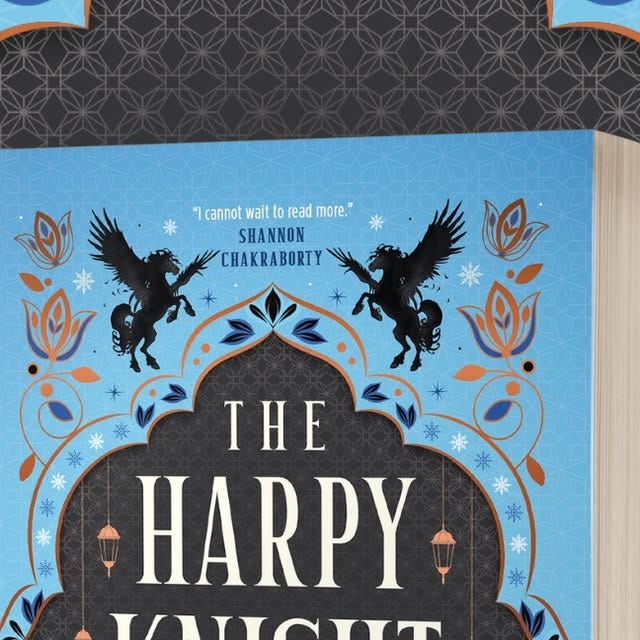
Update since my last newsletter: The Harpy Knight had a cover reveal! Lately, I’ve been most active on Instagram sharing some lovely book art, but I’ve been swamped with school, teaching, and writing. However, I’m very excited to share a special interview today.
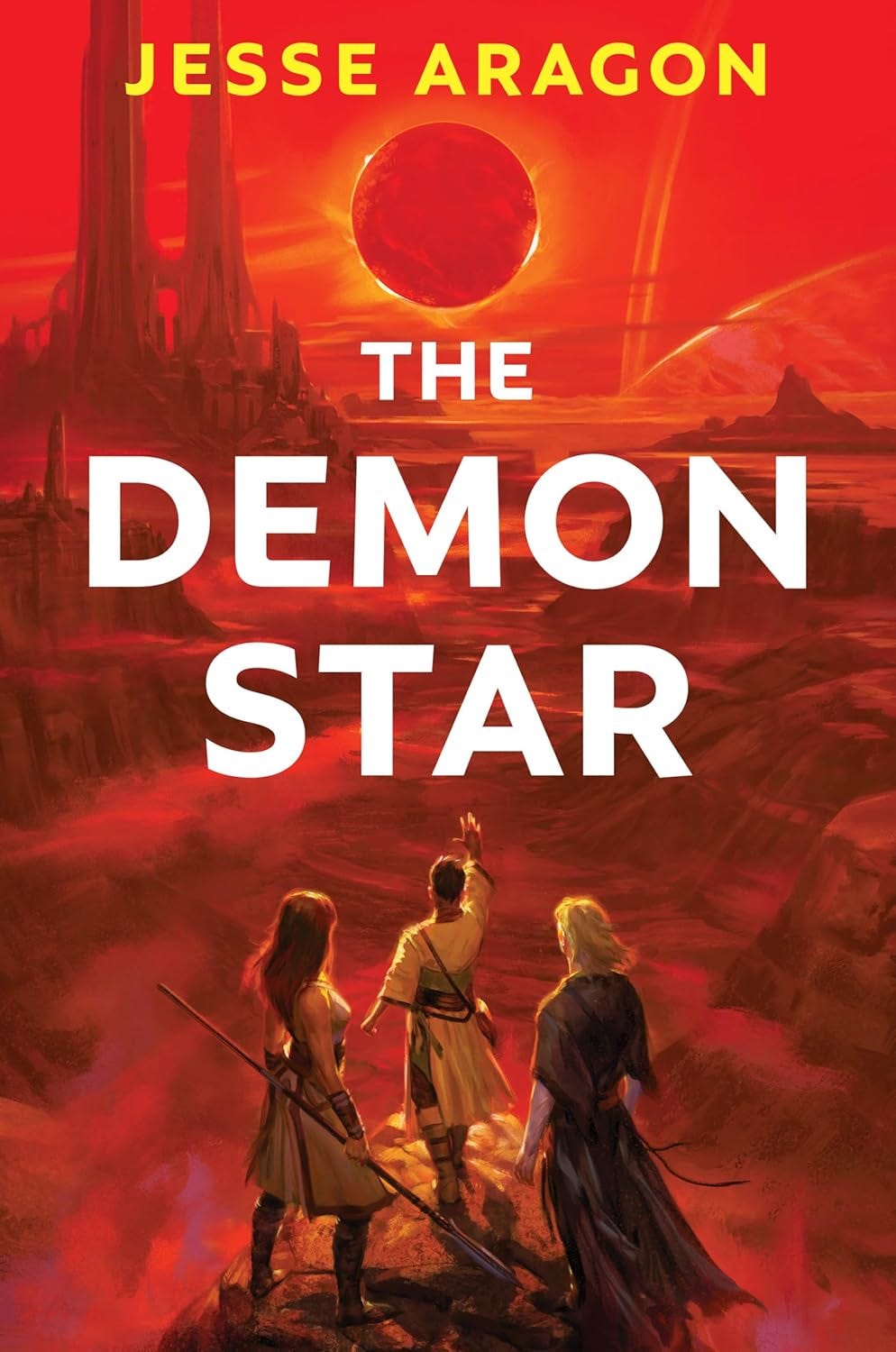
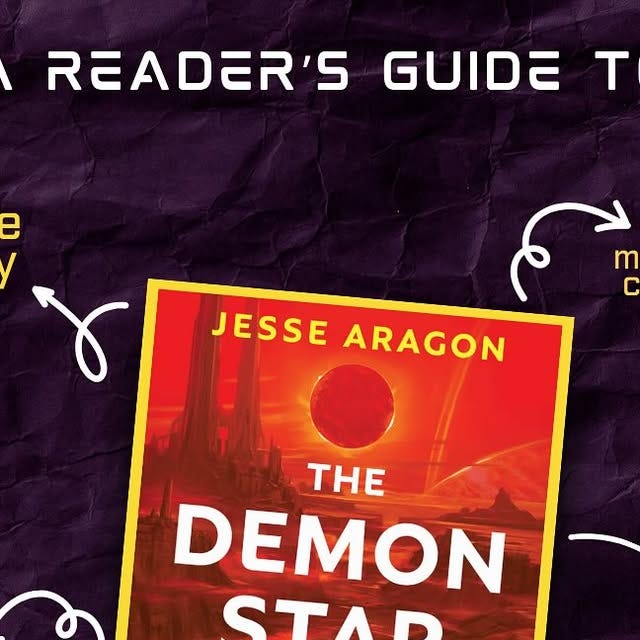
I spoke with Jesse Aragon, author of The Demon Star (forthcoming from DAW in 2026), about the philosophy of science-fantasy, arthropods, and telepathic priests.
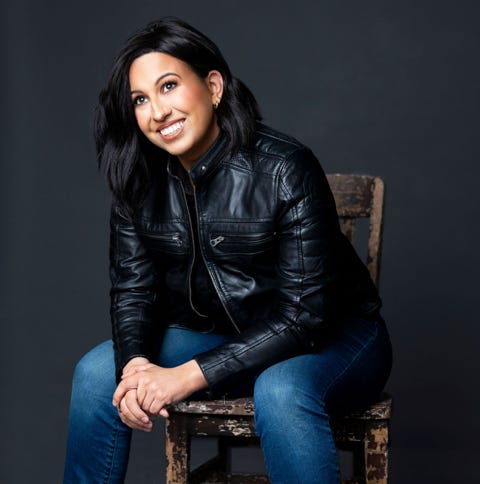
Jesse Aragon is a writer of sci-fi and fantasy, usually both at the same time. She loves morally complicated protagonists, horror, tragedy, the numinous, and stories that dive deep into the darkest, messiest parts of human nature.
When she’s not writing, she enjoys lifting weights (plus reluctant cardio), drawing (not well), gaming (casual), and watching very long, very niche YouTube video essays. She loves cats, green chiles, and UFO lore.
She grew up overseas, and “home” for her is everywhere from Brussels, Belgium to Albuquerque, New Mexico. She has a Psychology BA, an EMT-I license, and a BSN. She has been an usher, a cashier, a server, a home health aide, an EMT, an ER tech, and a trauma RN. Her jobs have consistently been much stranger than any fiction she writes.
Her debut novel, THE DEMON STAR, is forthcoming from DAW books in Spring 2026!
What inspired The Demon Star?
Aragon: This is an incredibly long story, which I have yet to condense to a pithy soundbite, so I apologize in advance for this:
In the words of Arthur C Clarke, “Any sufficiently advanced technology is indistinguishable from magic.” Lots of media has played with this idea. At a formative age I read Sylvia Engdahl’s Enchantress From the Stars, which Engdahl has described as “what if Starfleet took the Prime Directive seriously.” So in this book, you have these advanced alien anthropologists posing as wizards to help a roughly medieval society fight off another invading interstellar empire (they think their technology is magic).
As the story goes on, it deconstructs the motives and ethics of not just the invaders, but of the anthropologist “observers.” I won’t spoil it, but for me it raised all kinds of fascinating questions, especially about belief. You can have two people witnessing the exact same phenomenon and interpreting it in wildly different ways. Is it magic, or science? Does it matter? Do you assign existential significance to it, or do you not? What does it MEAN? Why are we here? Am I even real?
I had my first existential crisis at roughly age eleven, and have only gotten more annoying since then. I’m a hobbyist when it comes to existential philosophy, philosophy of religion, and philosophy of mind—everything from Aquinas to Kierkegaard to Nietzsche to CS Lewis to Thomas Nagel. The Demon Star’s original title, When All We’ve Known Are Shadows, is a reference to Plato’s Allegory of the Cave. My editor thought it was too literary, and she was probably right, but if you look closely you’ll still see the allusions in the book.
TLDR: “Science Fantasy” is the perfect intersection of genres at which to examine religion. I knew I wanted to do something with that, but it took me a while to figure it out.
I had a few false starts over the years while I wrote other books, and didn’t feel nearly skilled enough to do this idea justice. I finally started writing it in 2023, by which time I was so fed up with publishing, I was just like…. Fuck it. I’m going to talk about religious trauma and existential dread by way of arthropods, ridiculous action scenes, and interdimensional body horror. I’m putting everything I love into this book, it’s going to be completely batshit, and the characters are going to be a MESS. I’m going to write a plot that’s like a train crash you can’t look away from. And somehow I got away with it!
Where do you think you would rank in terms of telepathic strength as a priest in the Church of the Black Sun?
Aragon: Telepathic strength in this setting is quantified via “tiers.”
Tier 1: Most people. No telepathic ability.
Tier 2: Mildly more empathetic than normal, can usually tell when someone is lying to them.
Tier 3: Not strong enough to do anything exciting. They might be able to read thoughts—often by accident.
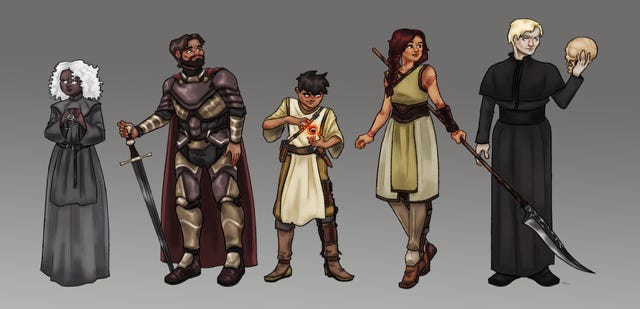
Tier 4: Minimum requirement to become a Priest of the Black Sun. They can communicate with demons, perform exorcisms, read thoughts, and influence emotions.
Tier 5: Same as Tier 4, but they are also capable of mind control, plus searching and altering memories.
Tier 6: Extremely rare. They can kill using only their minds.
Tier 7: Only the gods are this powerful. It’s unclear what all they can do.
I personally would be Tier 1, because I have been known to completely misread situations. For example: At all times, I assume everyone is mad at me and hates me.
Could you talk a little about your journey to publication? Any advice for authors looking to get traditionally published?
Aragon: It took me several versions of three books, queried over seven years, to land my first literary agent. I then had a book die a slow death on submission, and went back to the query trenches with my fourth book. I had my first offer of rep within ten days, and was only on sub for a week before my preempt. I’ve had two wildly different experiences, so I know firsthand how much of getting published depends on sheer luck.
Persistence is key. Publishing is not a meritocracy, but your luck can change at any time, and you want to be ready for when it does. I can’t tell you how many writers I know who had to slog through years of terrible luck before they finally wrote something that struck the exact right nerves at the exact right time. Some people hit it right away, but if you don’t, it says nothing about how hard you’ve worked or how much you deserve it.
Could you recommend another space opera with cosmic horror elements that anyone who enjoys The Demon Star would love? Bonus points if there are brain worms.
Aragon: REDSIGHT by Meredith Mooring - This has religious trauma, eldritch horrors, and weird, amazing worldbuilding—seriously I cannot say enough good things about the worldbuilding in this book.
THE STARS ARE LEGION by Kameron Hurley - While my favorite Hurley book is The Light Brigade, TSAL is much more disgusting. It makes the grossest parts of TDS look tame. Hurley is also a master of pacing and action sequences.
THE KING MUST DIE by Kemi Ashing Giwa - I haven’t read this one yet, but I did read this author’s debut, The Splinter In The Sky, and enjoyed it. I am dying to get my hands on her sophomore novel, because it looks like the exact brand of science fantasy I love.
BOOK OF THE NEW SUN by Gene Wolfe - This one is a bit hard to get through, but it’s worth the mental effort. The setting is a fascinating blend of post-apocalyptic, epic fantasy, and space opera, and I drew a lot of inspiration from it.
HYPERION by Dan Simmons - This book is basically The Canterbury Tales in space, so it’s a pretty eclectic mix of stories. I didn’t love all of them, but the priest’s tale has stuck with me like few other things I’ve read. It’s a brilliantly bleak exploration of faith and disillusionment, with a heavy dose of body horror.
Now I’m going to cheat and recommend a TV show: RAISED BY WOLVES. It’s a space opera horror drama about robots, religion, and, uh, snakes. It ran for two seasons before getting cancelled. It was so good and inspired me a LOT.
How important is diversity to you when constructing a science-fiction world?
Aragon: Very important! I grew up overseas in a multicultural environment, so it’s always been critical for me to write worlds that reflect the one I live in.
THE DEMON STAR takes place in a queer-norm setting, though there is a bit of… not outright discrimination, but weirdness surrounding gender. It’s my take on what might happen if a society that is very conscious of gender (as tied to biological sex) imposed their linguistic conventions on a society that doesn’t even do gendered pronouns. There’s some deliberate dissonance/inconsistency in there, which I didn’t get to explore much in this book, but it is present. I’m curious to see how many people (if any) end up noticing.
When it came to using a pen name, I had a lot of internal back and forth over whether I should use my legal last name, or my mom’s Hispanic maiden name. I eventually chose the latter because it’s reflected in the world of THE DEMON STAR, though the cultures depicted in the book aren’t meant to be directly analogous to anything IRL. There’s also the fact that there are so few Hispanic/Latinx folks getting traditionally published, especially in SFF, and ESPECIALLY in my subgenre. Considering the current political climate in the US, I want to be up front and proud about this part of myself.
What characteristics do you think make for the best morally gray characters? How do you write them?
Aragon: I think that first and foremost, you have to commit to it. I feel like a lot of characters advertised as “morally grey” are actually perfectly heroic, they just did a theft or a murder or something in desperate circumstances. They do bad things to survive and protect their loved ones, not out of selfishness or cowardice or carelessness. And maybe this is messed up of me, but I want to see more of the latter!
There should also be consequences. If the character does something bad, not everyone should agree with them or even forgive them. This means that you, as the author, have to be willing to risk people not liking them. I think my character writing got vastly better once I started worrying more about “realistic” than “likable.”
Even if you’re not trying to write a morally grey character, it’s important to let your characters screw up. No one is in the right 100% of the time. People make mistakes, they make bad decisions, and they hurt people they care about. For me, leaning into the messiness of human nature is key for crafting compelling characters.
What is your advice for writing memorable and unique alien races?
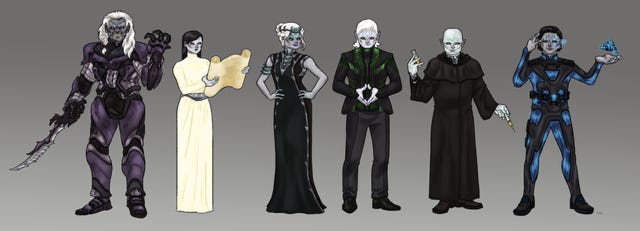
Aragon: I don’t know that I have any useful advice, but I can tell you what I did for the aliens in THE DEMON STAR!
It boils down to one specific pet peeve of mine: I don’t like elves. I don’t like most current depictions of fae. I don’t like that they live longer than humans, or that they’re better looking, AND more magically powerful, AND faster and stronger, etc etc. It’s obnoxious. I could also write a whole essay about how the idea of an objectively superior species in SFF is often handled in a way I find uncomfortable.
I do, however, like the “fair folk” that are genuinely unsettling and inhuman. I’m fascinated by the notion that UFO/alien abduction stories are our modern-day faerie stories. It made a lot of sense to me to combine the two.
You know what else I find unsettling? Arthropods. So I combined elves with arthropods, gave them fewer massive advantages over humans, and put them in space.
Could you talk a little bit about your experience working with DAW?
Aragon: So far it’s been great! I’ve been lucky to end up with a very attentive editor.
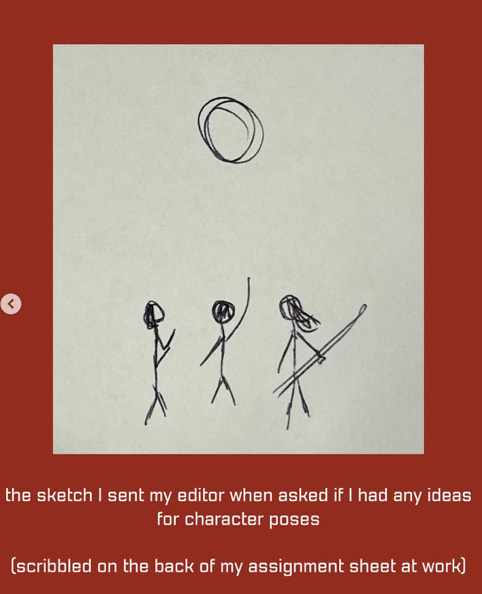
I was especially thrilled with how much input I got on the cover. For example, we were talking about poses for the characters on the cover, and I sent this horrible sketch, and the artist came up with something similar but way better!
What trends in science-fiction would you like to see coming soon? Or alternatively What genres do you think could really benefit from brain worms, telepathic priests, and toxic poly rep?
Aragon: I would love to see more epic fantasy in space, in the vein of Dune or Star Wars. I love fantasy for the scope, the worldbuilding, and the sense of the epic and mythical that you don’t often get from straight sci-fi. I ALSO love spaceships, wormholes, and conflicts that span across galaxies.
This is pretty much all I write, and it’s my favorite genre to read. I’d been struggling to get my work out there, and seeing very little of its kind in trad pub. For years the closest thing was Red Rising, which is great, but I really wanted MORE. It was very exciting when the Sun Eater series (also from my publisher!) started getting popular, because it shows there is a market for this sort of book. I hope there’s room for more diverse writers, because this subgenre is quite possible the whitest, most cishet male dominated one in the industry.
Can you tell me a little about your next project or something you’re working on and excited about?
Aragon: At the moment, TBD! I really hope to do a sequel, but all I can say for sure is that my next book will also be some kind of epic science fantasy or space opera.
Where can we find you to follow your work? (website, newsletter link, whatever you’d like to plug here.)
Aragon: authorjessearagon.com
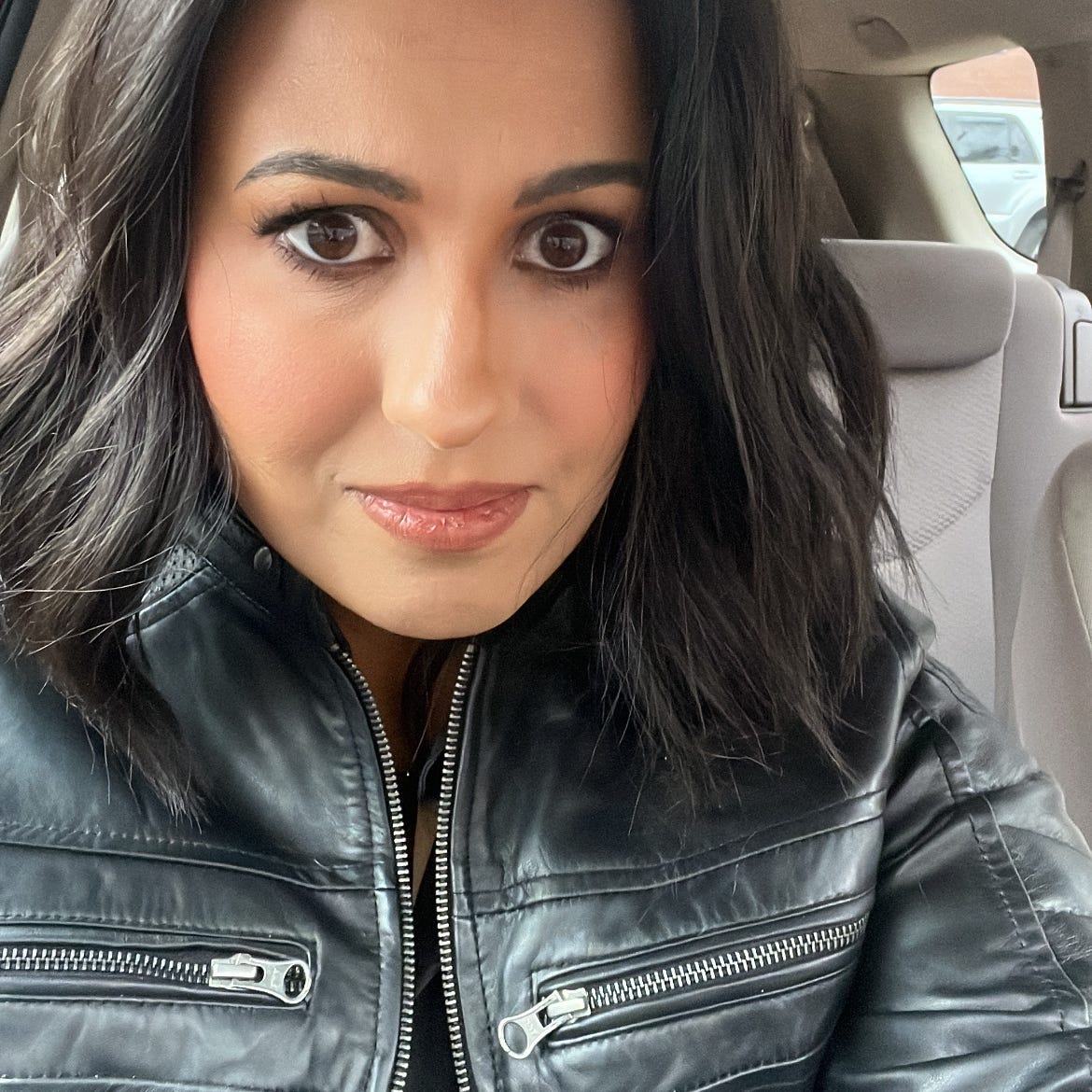
instagram: @jva_writes
What are you enjoying right now?
Aragon: This month I’ve had some time off work AND off deadline, so I’ve been reading some of my EXCELLENT fellow 2026 sci-fi debuts!
LOVE GALAXY by Sierra Branham
THE CELESTIAL SEAS by TA Chan
HOMEBOUND by Portia Elan
THE IRON GARDEN SUTRA by AD Sui
You can add THE DEMON STAR on Goodreads and preorder it now.